
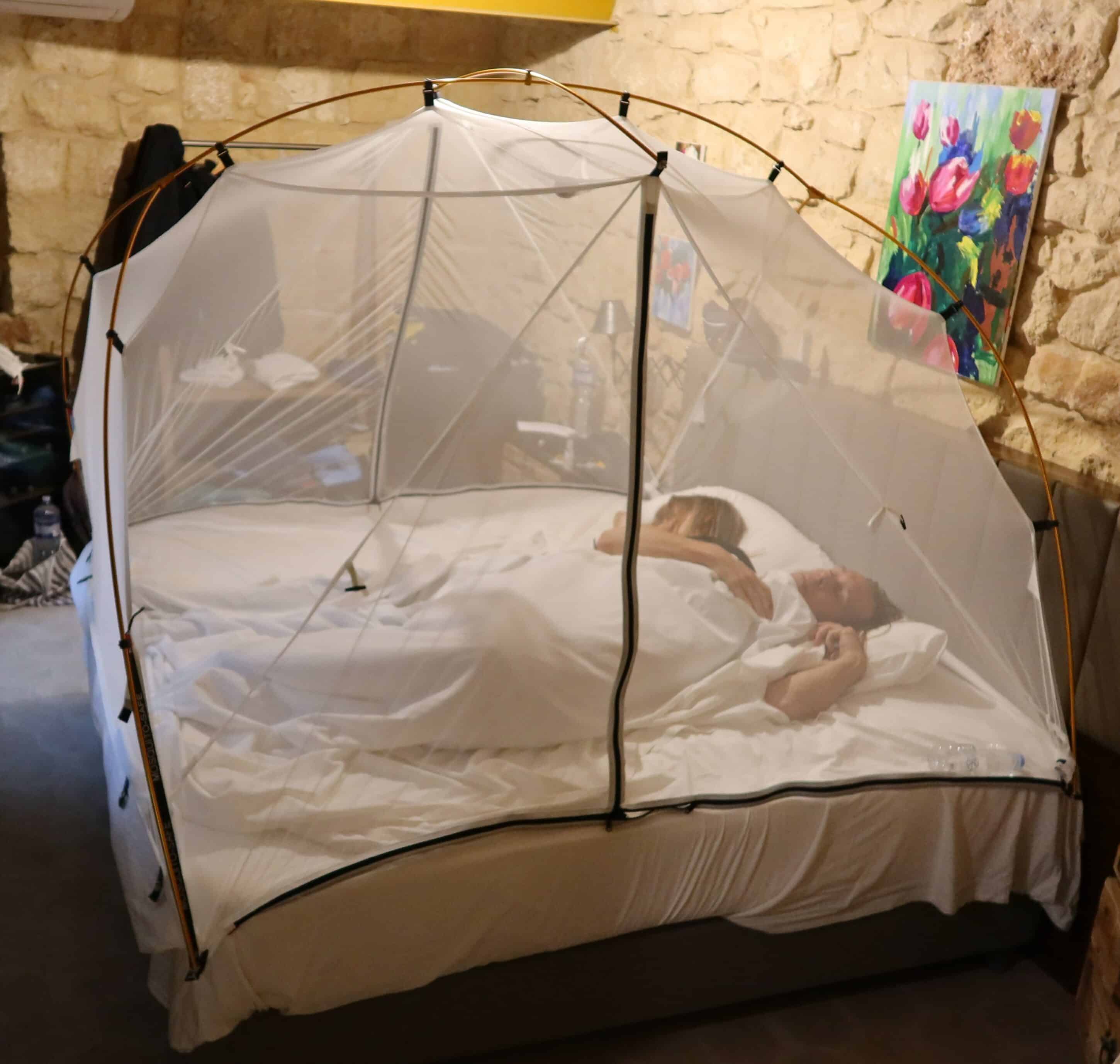
The Foreign Office recommends – depending on the way you travel or where you go – taking your own insect protection net from home. Ideally, it is a self-supporting dome-shaped design, with zippers and a stable bottom. Especially in risk areas an impregnated mosquito net should be used (see: GFO).
This is the verbatim recommendation by the German Foreign Office:
“[…]4. Use of Insect (Mosquito) Nets
The protective effect of bed nets in preventing malaria is undisputed. The malaria mosquito species most commonly distributed in many African high-risk areas shows the highest bite activity after midnight, when the effect of a contact repellent you used in the evening before going to bed may already be diminished. Bed nets are even recommended for accomodations with insect nets in the windows, since malaria mosquitos may enter the house in another way, which can never be excluded. If you need to lie down during the day, mosquito nets are highly suitable against diurnal bloodsucking insects […] In order to be prepared for all cases, mosquito nets are a highly recommendable travel accessory. Depending on the way you travel or where you go – taking your own insect protection net from home is recommended. If you are provided an insect protection net by your hotel, make sure there are no holes in it. When in doubt, use your own mosquito net. Self-supporting nets that are set up like tents are a practical alternative, and can be used on any kind of hotel bed. The freestanding dome tent with fiberglass poles and a zipper reliably keeps mosquitoes out, while the solid floor keeps out all kinds of crawling insects.
5. Waterproofing the insect screens
The efficiency of an insect net is considerably increased if it is impregnated with a contact insecticide that prevents mosquitos from biting body parts in direct contact with the mesh material or to search for gaps in the net. As soon as a mosquito lands on the net, the substance kills it immediately. Small holes that may have been overlooked cease to be dangerous. Very small flies like sandflies may even slip through coarser mesh material. By impregnating your mosquito net you can minimize this risk, and at the same time, you reduce the insect population in the room. This also minimizes your risk if you need to get up at night. […] Impregnated nets should be re-treated according to the manufacturer’s instructions and depending on their usage every 6 to 12 months. By now, long-lasting insecticide treated bed nets are available, too.[…] Air conditioned rooms are less dangerous, since mosquitos tend to avoid lower temperatures and become “lazy to bite”. Air conditioners should never be considered as a replacement for a mosquito net, though. [….]” (see: GFO)
Note:
The impregnation used in MOSQUITO-SAFE is non-toxic to living organisms—including humans. It doesn’t kill the mosquitos, it just keeps them away. The insect population in the room is not reduced by this kind of impregnation. Mesh and bottom material of the MOSQITO-SAFE tent have a long-lasting impregnation – so the MOSQUITO-SAFE is a long-lasting repellent (no insecticide) treated bed net. The impregnation contains an insect repellent, not an insecticide. The presence of this substance keeps insects away from all treated areas, without toxicity or negative effects on the environment. This impregnation is non-toxic, odorless and safe for infants 6 months and older, as well as for pregnant and breast-feeding women.
“[…] Native mosquito species also transmit diseases
It is not only invasive species such as the Asian tiger mosquito that can transmit diseases; native mosquitoes of the genus Culex […] can also transmit the West Nile virus and the Usutu virus to […] humans.[…]” (see: Stefanie Lambernd, NDR)
Avoid the regret of “if only …” thoughts during your next vacation!
Sources:
Federal Foreign Office (ed.) Exposure Prophylaxis, as of March 2019, pp. 3–5, accessed May 14, 2021
https://www.auswaertiges-amt.de/blob/251022/943b4cd16cd1693bcdd2728ef29b85a7/expositionsprophylaxeinsektenstiche-data.pdf
Stefanie Lambernd, NDR.de, Climate Change: Mosquitoes and Ticks Are Spreading (as of July 2019), Accessed May 15, 2021
https://www.ndr.de/ratgeber/klimawandel/Klimawandel-Beste-Bedingungen-fuer-Muecken-und-Zecken,invasivearten100.html
0 Comments